
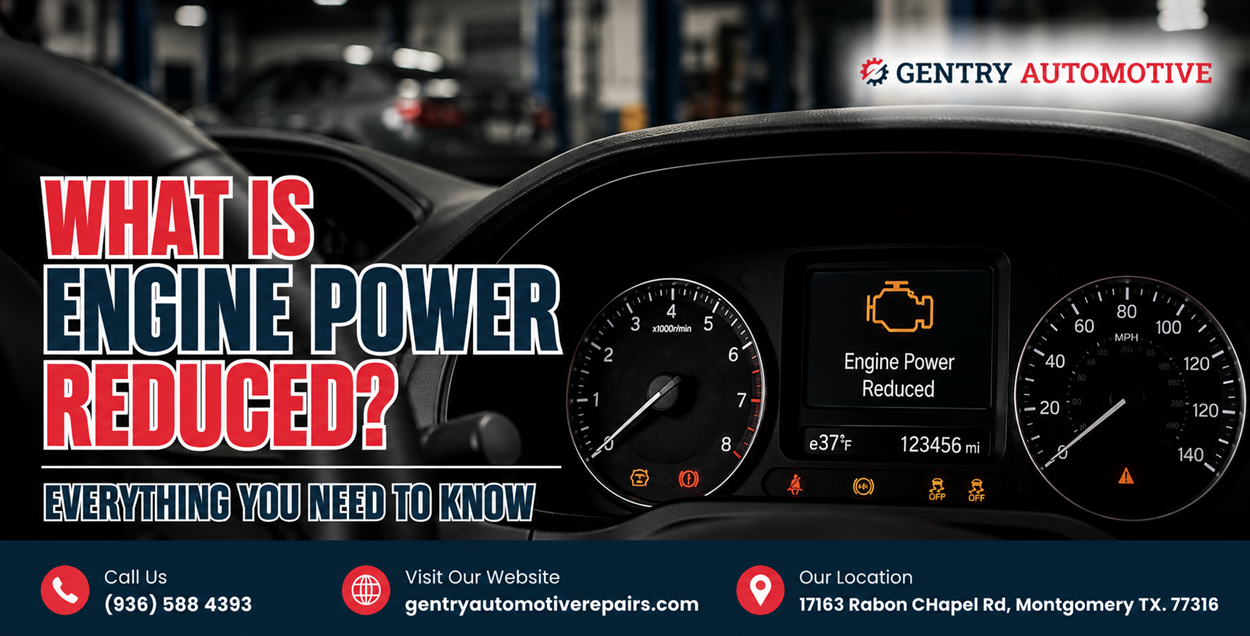
Few dashboard warnings grab a driver’s attention like “Engine Power Reduced.” One moment your car is driving normally, and the next it feels slow, struggles to accelerate, or won’t go above a certain speed.
If you’ve seen this warning, don’t panic, but don’t ignore it either.
Reduced engine power is your vehicle’s way of protecting itself when it detects a problem that could damage the engine or other important components. Instead of allowing the engine to run at full performance, the car limits power until the issue is diagnosed and repaired.
In this guide, you’ll learn what reduced engine power means, what causes reduced engine power, the symptoms to watch for, whether it’s safe to continue driving, and when it’s time to visit a repair shop.
What Does “Engine Power Reduced” Mean?
Think of your car like a smartphone. When a phone gets too hot, it slows itself down to protect the battery and the processor. Your car does something similar.
Modern vehicles have a computer that keeps an eye on the engine every second you’re driving. It checks information coming from different sensors and makes sure everything is working the way it should.
If the computer notices a problem that could damage the engine or make the car unsafe to drive, it may reduce the amount of power the engine can produce.
That’s when you see the engine power reduced message. Many people call this limp mode because the car is still able to move, but it won’t perform like it normally does. The reduced power isn’t the real problem. It’s a warning that another issue needs attention.
What Are the Common Symptoms?
Every vehicle reacts a little differently, but most drivers notice the change almost immediately. Your car might:
- Take much longer to speed up.
- Feel slow when you press the gas pedal.
- Struggle to climb hills.
- Stay stuck at a lower speed.
- Turn on the Check Engine Light.
- Idle roughly while sitting at a stoplight.
Some drivers say the vehicle feels perfectly normal until they try to accelerate. Others notice the lack of power as soon as they start driving. Either way, if the warning appears, it’s worth getting the car checked.
What Causes Reduced Engine Power?
There isn’t just one answer. In fact, what causes engine power to be reduced can vary from one vehicle to another. The engine computer doesn’t reduce power for no reason. It’s reacting to a problem somewhere in the system. Here are some of the most common causes.
A Dirty or Faulty Throttle Body
This is one of the problems technicians see most often. The throttle body controls how much air goes into the engine. More air means the engine can make more power. Over time, dirt and carbon can build up inside it. Sometimes the electronic parts inside the throttle body simply wear out.
When that happens, the engine computer may stop trusting the throttle and limit engine power instead.
Bad Sensor
Your vehicle depends on sensors. They measure things like airflow, engine temperature, fuel pressure, and how far you’ve pressed the accelerator pedal.
If one of those sensors starts sending incorrect information, the computer has no way of knowing whether the engine is actually okay.
Rather than taking a chance, it plays it safe and reduces power.
Fuel System Problems
The engine cannot produce normal power without sufficient fuel pressure. Common fuel-related causes include:
- Weak fuel pump
- Clogged fuel filter
- Dirty fuel injectors
- Fuel pressure regulator issues
These problems may become more noticeable during hard acceleration or highway driving.
Ignition Problems
Spark plugs and ignition coils help ignite the fuel inside the engine. When one starts failing, the engine can misfire. That often feels like shaking or stumbling while driving.
If the misfires continue, the computer may reduce engine power to help prevent damage to expensive parts like the catalytic converter.
Wiring Issues
Sometimes the problem isn’t a major component at all. A loose connector, damaged wire, or corrosion can interrupt communication between sensors and the engine computer.
These electrical faults can be frustrating because they may come and go. One day, the warning appears. The next day, it disappears. That doesn’t always mean the problem fixed itself.
Is It Safe to Drive with Reduced Engine Power?
One of the most common questions drivers ask is “Is it safe to drive with reduced engine power?” The short answer is: only for a short distance if the vehicle is still operating safely.
If the warning appears and the vehicle still drives normally enough to reach a nearby repair shop, you can usually continue cautiously.
However, you should avoid:
- High-speed driving
- Heavy acceleration
- Long road trips
- Towing heavy loads
- Driving in heavy traffic, if the vehicle struggles to maintain speed
If the vehicle begins shaking, stalls repeatedly, overheats, or loses significant power, it’s safest to stop driving and arrange for professional assistance.
Continuing to drive with a serious engine or transmission problem can turn a relatively small repair into a much larger and more expensive one.
Can the Warning Reset on its Own?
Sometimes, temporary sensor glitches or moisture-related electrical issues may disappear after restarting the vehicle. However, that doesn’t necessarily mean the underlying problem is gone.
Many drivers report seeing the warning disappear for days or even weeks before returning unexpectedly. Even if the message clears, the vehicle should still be inspected. Modern diagnostic equipment can often detect stored fault codes that help identify the original cause before it becomes a bigger problem.
Can You Fix Reduced Engine Power Yourself?
That depends on what’s causing it. Simple issues like replacing a dirty air filter or tightening a loose electrical connector may be manageable for experienced DIYers. However, many repairs involve electronic throttle systems, advanced sensors, or computer diagnostics that require specialized equipment.
If you’re searching for step-by-step solutions, we’ve also created a complete guide on how to fix engine power reduced that walks through the most common repairs, troubleshooting steps, and when professional service is the better option. Be sure to check it out after reading this guide.
Wrapping Up
An engine power reduced warning isn’t something to ignore, but it also doesn’t automatically mean your engine is failing.
In many cases, the system is doing exactly what it was designed to do, which is protecting your vehicle from more serious damage. The challenge is identifying the underlying cause quickly, whether it’s a faulty throttle body, sensor issue, fuel system problem, or something more complex.
If your vehicle repeatedly enters reduced power mode or the warning is accompanied by poor performance, unusual noises, overheating, or a check engine light, a professional inspection is the safest next step.
For drivers across Texas, including those in Montgomery, the experienced technicians at Gentry Automotive Repairs can accurately diagnose reduced engine power issues and recommend the right repair, helping you get back on the road with confidence. Schedule an inspection today!
FAQs
1. What does “Engine Power Reduced” mean?
“Engine Power Reduced” means your vehicle’s computer has detected a problem and is limiting engine performance to help protect the engine or other components.
2. What causes reduced engine power in a car?
A dirty or faulty throttle body, bad sensors, fuel system problems, ignition issues, wiring faults, or other engine and electrical problems can cause reduced engine power.
3. Can I drive my car with the “Engine Power Reduced” warning?
You may be able to drive a short distance if the vehicle is operating safely, but avoid high speeds, hard acceleration, and long trips. If the car shakes, overheats, stalls, or loses significant power, stop driving and have it inspected.
4. How do I fix an “Engine Power Reduced” warning?
The fix depends on the underlying problem. A technician may need to scan the vehicle for trouble codes and inspect the throttle body, sensors, fuel system, ignition components, and wiring before recommending a repair.
5. Where can I get Engine Power Reduced diagnosed in Montgomery, TX?
For professional diagnosis and repair, Gentry Automotive Repairs provides engine diagnostics and auto repair services in Montgomery, TX. Their technicians can identify the cause of reduced engine power and recommend the appropriate repair.