



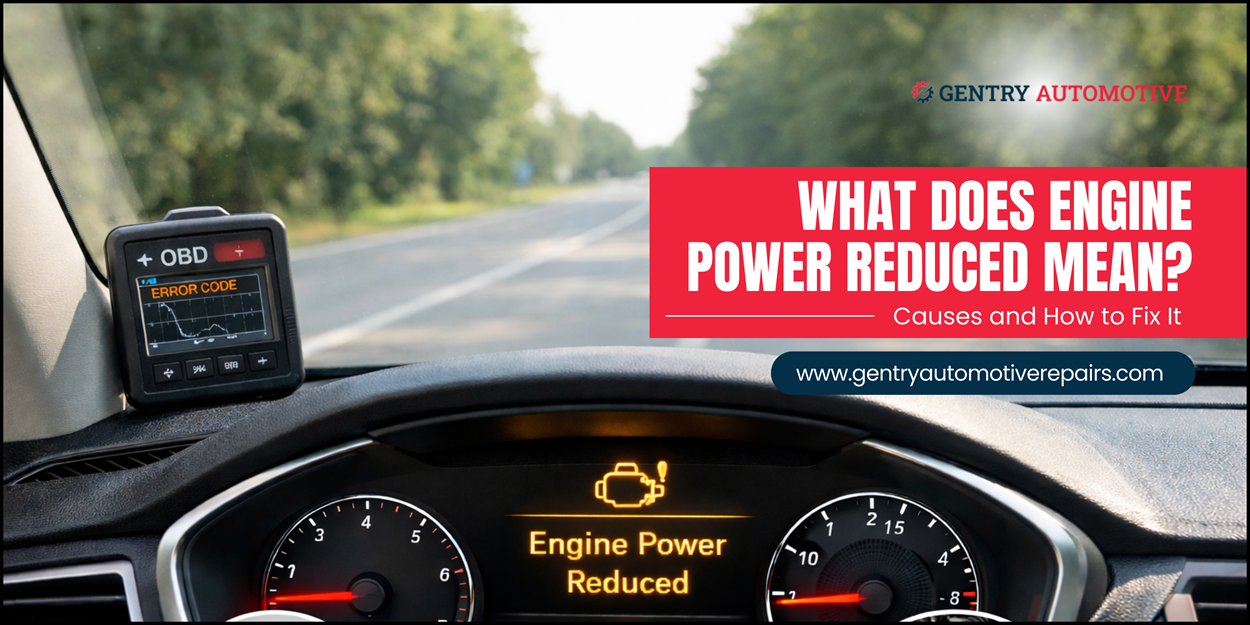
Seeing the “engine power reduced” message on your dashboard is an immediate cause for concern. It isn’t just a random maintenance light. It is a critical safety state officially known as “Limp Mode.”
When this happens, your car’s internal computer has identified a data mismatch or a mechanical failure that could lead to engine destruction. To prevent this, the vehicle restricts acceleration and limits engine speed (RPM), effectively forcing you to slow down and seek repairs immediately.
What Causes Reduced Engine Power?
Because modern vehicles are essentially computers on wheels, the triggers for reduced engine power can range from minor sensor glitches to major mechanical failures. Common culprits include:
- Electronic Throttle Control (ETC) Issues: A faulty throttle body or a failing accelerator pedal sensor is the most frequent cause. If the ECU can’t verify exactly how much air is entering the engine, it cuts power for safety.
- Mass Air Flow (MAF) or Oxygen Sensor Failure: These sensors monitor the air-to-fuel ratio. If they send “garbage” data to the computer, the system defaults to a low-power state.
- Cooling System Problems: If the engine begins to overheat, the ECU will reduce power to lower the internal temperature.
- Transmission Faults: A slipping clutch or a failing solenoid can trigger a power reduction to prevent the gearbox from shredding itself.
How to Fix Reduced Engine Power?
If you find yourself in this situation, do not ignore it. Driving for extended periods in limp mode can lead to secondary damage, such as a clogged catalytic converter or warped engine heads.
- Pull Over Safely: Find a safe spot and turn the engine off. Sometimes, a simple “reboot” of the car’s computer can clear a temporary sensor glitch.
- Check Fluid Levels: Inspect your oil and coolant. Low levels often trigger safety protocols.
- Use an OBD-II Scanner: Every message on your dashboard is accompanied by a stored error code. Plugging in a scanner will tell you exactly which sensor or system failed.
- Inspect the Throttle Body: Often, carbon buildup on the throttle plate causes it to stick. A simple cleaning with a specialized spray can sometimes resolve the issue.
Get Back on the Road With a Professional Diagnosis
Ignoring this warning only leads to more expensive repairs down the line. Whether it’s a simple sensor cleaning or a complex electrical fault, you need an expert eye to ensure the fix sticks. For drivers in Montgomery, Texas, the team at Gentry Automotive specializes in pinpointing these exact failures and getting you back to full power without the guesswork.