



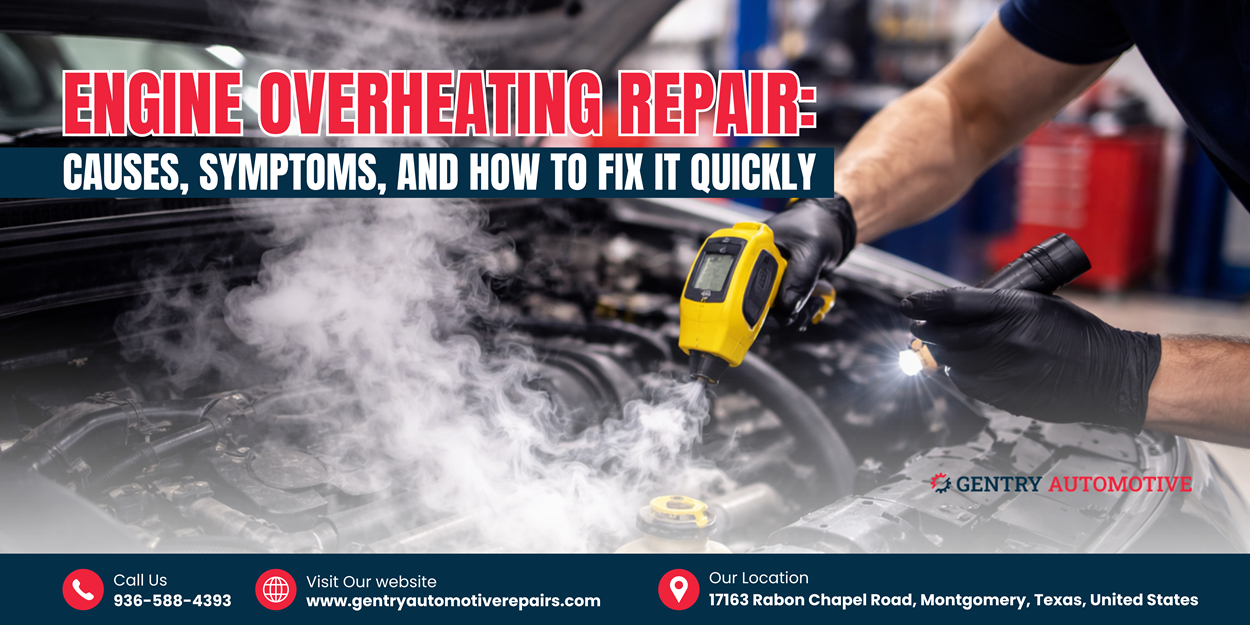
Engine overheating is one of the most critical mechanical failures a driver can face. It is extremely dreadful to see smoke coming out from under your hood while driving. Now, if this happens, it is important not to disregard this just as an inconvenience. To prevent total engine loss, it is essential to understand the mechanics and causes of engine overheating.
This guide will provide you with a technical breakdown of engine overheating and the necessary steps for lasting repair. Let’s get started!
Why is My Car Engine Overheating?
The cooling system of your car is a pressurized loop, and any breach in that loop will cause temperatures to spike within minutes. Commonly, the culprit is one of three things:
- Coolant Loss: Whether it’s a pinhole leak in a hose or a cracked radiator tank, if the liquid isn’t there to carry the heat away, the engine has no defense.
- Mechanical Failure: The water pump is the heart of the system. If the impeller blades are eroded or the bearing fails, the coolant sits still and boils.
- Airflow Obstruction: Your radiator needs a constant stream of air. If your cooling fans aren’t spinning or the radiator fins are packed with road debris, the heat has nowhere to go.
Primary Causes of Engine Overheating
To fix the problem, you have to diagnose the “how.” Here are the most frequent causes of engine overheating found in modern vehicles:
Thermostat
The thermostat is a small valve that stays closed until the engine reaches operating temperature. If it gets stuck in the closed position, it acts like a dam, preventing coolant from reaching the radiator. This is a cheap part that causes expensive problems.
Failed Water Pump
The water pump is responsible for circulating coolant throughout the block. If you hear a high-pitched whining noise or see coolant leaking from the pump, your circulation is compromised.
Cooling Fan Malfunction
This is the primary reason for an idle engine. When you are moving, the wind does the work. When you stop at a light, the electric fans must kick in. If the fan motor or the relay is dead, the temperature will climb the moment you stop moving.
Air Pockets in the System
If you recently had service and the system wasn’t checked correctly, an air bubble can form. This air pocket prevents the coolant from flowing, leading to localized “hot spots” that can crack an engine block.
Car Engine Overheating Symptoms You Should Not Ignore
Your car will almost always try to warn you before the metal starts to melt. Pay attention to these major things:
- Sweet Smell: If you smell something like maple syrup, that’s ethylene glycol (coolant) burning. You probably have a leak in the system.
- The Ticking Sound: As engine oil thins out due to extreme heat, it loses its lubricating properties, often resulting in a metallic ticking or tapping sound from the valvetrain.
- Reduced Power: Modern cars will often enter “Limp Mode” to protect themselves, cutting power drastically when they sense a dangerous temperature spike.
How to Handle an Overheating Emergency in Your Car?
If you are on the road and the light comes on, your priority is to save the engine.
- Turn off the A/C: The air conditioner puts a massive load on the engine, its best to switch it off first.
- Turn up the Heat: This sounds counterintuitive, but turning your heater to “Blast” acts as a secondary radiator, pulling heat away from the engine and into the cabin. It will be uncomfortable for you, but it might save your head gasket.
- Pull Over and Kill the Ignition: Do not try driving home. Every minute the engine runs while hot increases the chance of permanent damage.
- Never open a Hot Radiator Cap: This cannot be stressed enough. The system is under immense pressure. Opening that cap will result in a geyser of boiling coolant that can cause third-degree burns.
DIY or Professional Automotive Repair?
When it comes to overheated engine repair, the “quick fix” is rarely the right fix. Adding a bottle of stop leak is a temporary bandage that often clogs the narrow passages of your heater core and radiator, leading to even worse problems down the line.
A professional repair involves a systematic pressure test to find leaks, a combustion leak test to ensure the head gasket hasn’t already failed, and a thorough flush of the system to remove scale and debris. If your radiator is clogged internally, no amount of flushing will save it; replacement is the only viable path.
Small Engines vs. Passenger Vehicles
It is worth noting that while we focus on cars, cooling principles apply across the board. Whether you are dealing with a four-wheeler or a lawn tractor, the physics are the same. If you have equipment that is running hot, don’t take it to a generalist.
Seek out a specialized small engine repair shop for things like generators or mowers, as their cooling fins and air-cooled shrouds require a different diagnostic approach than the liquid-cooled systems in your truck.
Preventative Measures to Avoid Overheating Your Engine
- Flush your coolant every 30,000 to 50,000 miles. Over time, coolant becomes acidic and begins to eat away at your gaskets and seals.
- Inspect your hoses. If they feel crunchy or excessively soft/spongy, they are on the verge of failure.
- Watch the debris and periodically spray out your radiator fins with a garden hose (not a high-pressure power washer) to ensure airflow isn’t blocked by leaves or bugs.
Bottom Line
Repairing an overheating issue requires precision. A missed diagnosis can lead to the car overheating again two days later, potentially finishing off an engine that was already weakened. You need technicians who understand the nuances of pressurized cooling systems and the thermal limits of modern alloy engines.
If you find yourself stranded or noticing a climbing temperature gauge in the Montgomery, Texas area, the team at Gentry Automotive Repairs provides expert diagnostics and comprehensive cooling system repairs to get you back on the road safely.
FAQ
-
Is a car ruined if it overheats?
No, not necessarily. However, it depends on how long you ran the car while it was hot. If shut down immediately, you may only need a minor repair. If driven till it stalls, the engine could suffer from warped heads, melted pistons, or even a cracked block.
-
Can I still drive if my engine overheats?
No, continuing to drive with an overheating engine could be life-threatening. Pull over safely and shut the engine off as soon as the temperature gauge climbs above normal range.
-
Can low oil cause overheating?
Yes, motor oil is responsible for about 40-42% of engine cooling. When it is low, friction increases, generating excess heat that the cooling system may not be able to offset.
-
How long does it take to fix an overheated engine?
It depends on the cause. Simple repairs take about 1-3 hours, whereas complex repairs, such as a head gasket or engine rebuild, could take several days to a week.
-
Does opening your hood cool the engine?
Yes, opening the hood allows trapped heat to escape into the atmosphere faster. But make sure not to touch the radiator cap or any hoses until the engine has cooled for at least 30-45 minutes.
-
Is it expensive to fix an overheating engine?
The cost varies based on the damage and your reaction time. Replacing a thermostat or cooling fan is relatively inexpensive, but repairing a blown head gasket or a cracked engine block will cost much more.